MBA Chula Global Business Experience: Executive MBA Class 41 | Düsseldorf 2026
MBA Chula Global Business Experience: Executive MBA Class 41 | Düsseldorf 2026
ZWILLING – The Secret Behind a Global Brand with a Nearly 300-Year Legacy
📍 October 13, 2026 | Solingen, Germany
The study visit to Germany for the Executive MBA Chula Class 41 cohort began with a tour of the ZWILLING J.A. Henckels factory in Solingen—a city renowned for its German knife-manufacturing industry.
Founded in 1731, ZWILLING stands as one of the world’s oldest brands. It serves as a prime example of a business that has successfully maintained its reputation for quality while adapting to technological shifts and market competition for nearly three centuries.
🔹 Behind the Success in Manufacturing
This visit provided an up-close look at the production process behind their world-class knives—from the integration of automation and robotics to enhance manufacturing efficiency, to rigorous quality control systems. According to information shared during the visit, the company produces as many as 4 million knives annually.
What is particularly impressive is the seamless blend of German engineering expertise with innovation and sustainability—evidenced by the company’s in-house technological development and its commitment to optimizing resource efficiency. ...and the application of Circular Economy concepts within the production process.
🔹 From a Knife Brand to a Global Kitchenware Conglomerate
Another compelling strategy is business expansion through strategic acquisitions—acquiring leading brands with specialized expertise from various countries, such as:
🇫🇷 STAUB – A French brand renowned for cast-iron pots and cookware.
🇧🇪 DEMEYERE – A Belgian specialist in high-quality stainless steel cookware.
🇮🇹 BALLARINI – An Italian brand known for its pans and cookware.
🇯🇵 MIYABI – A Japanese-style knife brand that blends traditional craftsmanship with modern technology.
This strategy has enabled ZWILLING to evolve from a knife manufacturer into a global kitchenware group, allowing it to reach a diverse customer base while preserving the unique identity and core strengths of each individual brand within its unified portfolio.
🔹 Lessons from a Brand Nearly 300 Years Old
This study visit highlights that the success of a sustainable business is not driven solely by its reputation or long history; rather, it stems from a steadfast commitment to quality, continuous innovation, efficient production management, and the selection of appropriate growth strategies.
-----------------------------------------------------
October 14, 2026 | Düsseldorf, Germany
(Morning Session)
On the second day of their study visit to Germany, students from the Executive MBA Chula Class 41 visited the ERGO Group—a leading German insurance group and a subsidiary of Munich Re, a global powerhouse in reinsurance and risk management.
Operating in over 20 countries, ERGO employs a workforce and agent network totaling more than 36,000 people. In 2025, the company generated 21.7 billion euros in insurance revenue, spanning life, health, property and casualty, and other insurance-related services. This visit offered a valuable opportunity to learn how a large-scale organization—operating within a highly regulated, high-risk sector like insurance—can foster innovation and adapt to rapid technological change.
🔹**Innovation Strategy: Explore, Make & Buy**
ERGO employs an "Explore, Make, and Buy" framework for innovation. This approach helps the company determine whether to explore and experiment with new technologies, develop solutions in-house, or acquire technology from external sources—such as through partnerships with startups.
Decisions are guided by factors including technological maturity, time-to-market, costs, risks, and business alignment. The process emphasizes validating concepts through a "Proof of Concept" (PoC) phase before scaling them for full-scale implementation.
🔹**AI & Digital Transformation**
ERGO places a strong focus on leveraging AI to enhance operational efficiency and elevate the customer experience. ...and creating new business opportunities—most notably by integrating AI into internal data and processes. However, a key challenge for the insurance industry lies in ensuring data security and adhering to stringent regulatory compliance. Consequently, any technological development must prioritize security and reliability alongside operational efficiency.
🔹 Barriers to Innovation & People Transformation
In large organizations, obstacles to innovation stem not merely from a lack of technology, but also from complex bureaucratic systems, a tendency for employees to remain within their "comfort zones" (clinging to established, familiar ways of working), as well as budgetary constraints and the inherent risks associated with investment.
To address this, ERGO emphasizes embracing external ideas, collaborating with startups, and piloting small-scale projects before scaling them up. Furthermore, the company focuses on reskilling its workforce, ensuring that employees are well-prepared to adapt alongside evolving technologies.
This study visit highlights that fostering innovation within a large organization requires more than just investing in cutting-edge technology; it demands a shift in mindset, work processes, and corporate culture—coupled with the ability to manage risks and strategically invest in innovations that deliver genuine business value.
(Afternoon Session)
The 41st cohort of the Chula Executive MBA program attended a lecture titled “Germany’s Economy & Hidden Champions,” delivered by Prof. Andreas Engelen from Heinrich Heine University Düsseldorf (HHU). The session explored the factors that propelled Germany to become a global economic and industrial powerhouse, as well as the challenges it faces in maintaining its competitive edge.
🇩🇪 1. The German Economy: From Success to Challenges
Germany’s economic strength is rooted in investments in education, engineering, technology, and manufacturing expertise—particularly within the automotive, machinery, chemical, and pharmaceutical sectors. These areas have long provided a competitive advantage and served as key drivers for the country’s exports.
However, Germany currently faces several challenges, including high energy and labor costs, an aging society, a shortage of highly skilled labor, a complex bureaucratic system, intensifying competition from China, and the broader shifts within the global economy.
Consequently, the critical task for Germany is not merely to preserve past successes, but to adapt and forge new forms of competitiveness to navigate a rapidly changing global economic landscape.
🏆 2. Hidden Champions: The Unseen Engines of the Economy
Another key topic was the concept of “Hidden Champions”—companies that may not be widely known to the general public, yet serve as global leaders within their specific niche markets. Many of these firms belong to the Mittelstand (small and medium-sized enterprise) sector, which forms the cornerstone of the German economy.
The term “Hidden Champions” was coined by Hermann Simon to describe highly specialized companies. These companies hold top-tier global market shares, yet they are not widely known.
What drives the global success of these firms?
🔹 Global Leadership: They are leaders in specialized global niche markets.
🔹 Specialization: They focus their expertise on their core business areas.
🔹 Innovation & Quality: They consistently invest in innovation and quality.
🔹 Long-term Orientation: They prioritize stable, long-term growth.
🔹 Regional Roots, Global Reach: Despite being based in small towns or local communities, they are able to expand their reach and compete on a global scale.
💡** Key Insight from the Study Visit **
The appeal of "Hidden Champions" lies in their strategic choice to compete in markets that may be small compared to mass markets. Through deep expertise and an exceptional ability to address specific customer needs, they have managed to establish market leadership and expand their businesses globally.
-----------------------------------------------------
Inside the Steel Industry — Exploring Steel Production Processes and the Transition Toward a Low-Carbon Industry
📍 October 15, 2026 | Duisburg, Germany
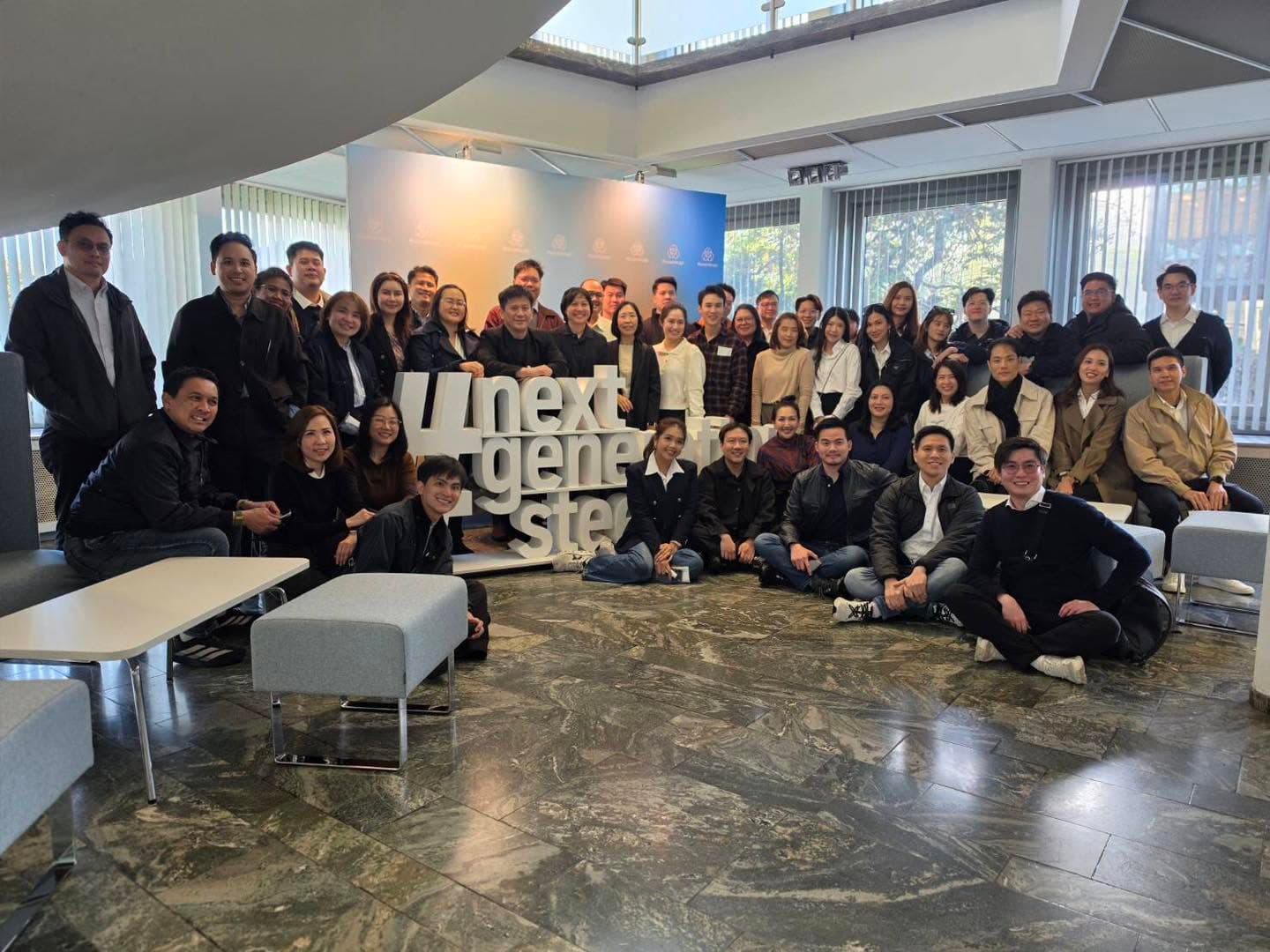
On the third day of their study visit to Germany, students from the 41st cohort of the Chula Executive MBA program toured a steel production facility operated by Thyssenkrupp Steel—one of Germany’s major steel manufacturers—to gain insight into the end-to-end steel production process and strategies for refining operations to reduce carbon dioxide (CO₂) emissions.
During this visit, the students explored several key areas, including:
🔹 1. Integrated Steel Production: From Raw Materials to Finished Steel Products
The group learned about the entire steelmaking workflow—from the preparation of coal and iron ore and the use of blast furnaces, to steel refining, continuous casting, hot and cold rolling, and surface coating. These interconnected stages form a large-scale production system designed to create high-quality steel for various sectors, such as automotive, home appliances, and packaging.
🔹 2. Green Steel Transformation: Transitioning to a Low-Carbon Steel Industry
One of the most compelling topics covered was the transformation of steel production processes to lower CO₂ emissions—a critical challenge for the global steel industry. Thyssenkrupp Steel is prioritizing the development of low-carbon production technologies, specifically through the use of direct reduction and hydrogen, to decrease reliance on traditional, coal-based smelting methods. This transition involves more than just a change in technology; it entails significant investment, infrastructure restructuring, energy management, and the maintenance of production efficiency alongside environmental goals.
-----------------------------------------------------
Lanius-Knab Winery — Exploring a Family Wine Business with Over 200 Years of Heritage
📍 October 16, 2026 | Oberwesel, Germany
Students from the 41st cohort of the Chula Executive MBA program visited Weingut Lanius-Knab, a family-owned winery in Oberwesel, located in Germany’s Rhine Valley. The estate boasts a 250-year legacy of viticulture and winemaking and is situated within the Upper Middle Rhine Valley—a UNESCO World Heritage site.
🍇 Family Business & Long-term Orientation
Lanius-Knab is a family enterprise that has passed down winemaking knowledge and expertise through generations. The business prioritizes the long-term preservation of quality, reputation, and brand identity, while simultaneously pursuing continuous development. They skillfully blend traditional wisdom with modern production techniques, creating added value rooted in the unique character of the local terroir.
🍷 Quality & Differentiation
The distinctiveness of their wines stems from vineyards planted on the steep slopes along the Rhine River. The Riesling grapes, in particular, are shaped by the specific soil composition, microclimate, and sunlight exposure of each individual site, lending a unique signature to the wine from every plot.
Furthermore, Lanius-Knab is a member of the VDP—an association of Germany’s top-tier quality wine producers—underscoring their commitment to rigorous quality standards and their strategic positioning within the premium wine market.
#MBAChula #ExecutiveMBAChula #EMBA41 #GermanyStudyTrip #LaniusKnab #FamilyBusiness #BrandDifferentiation #Sustainability #Leadership
#CBSEL #CBSChula #ChulalongkornBusinessSchool #MBAChulaGlobalBusinessExperience
Gallery